Of course, the Zeitgeist doesn’t hold watches up to the paparazzi’s cameras on red carpets, or quickly have a watch strapped to its wrist after a Formula 1 victory, like the usual influencers. The Zeitgeist is, by definition, the most important influencer in the world – because it influences everyone, through culture.
How the Zeitgeist does that today, I don’t know. Maybe these days he’s hanging out with rappers and wearing an iced-out AP.
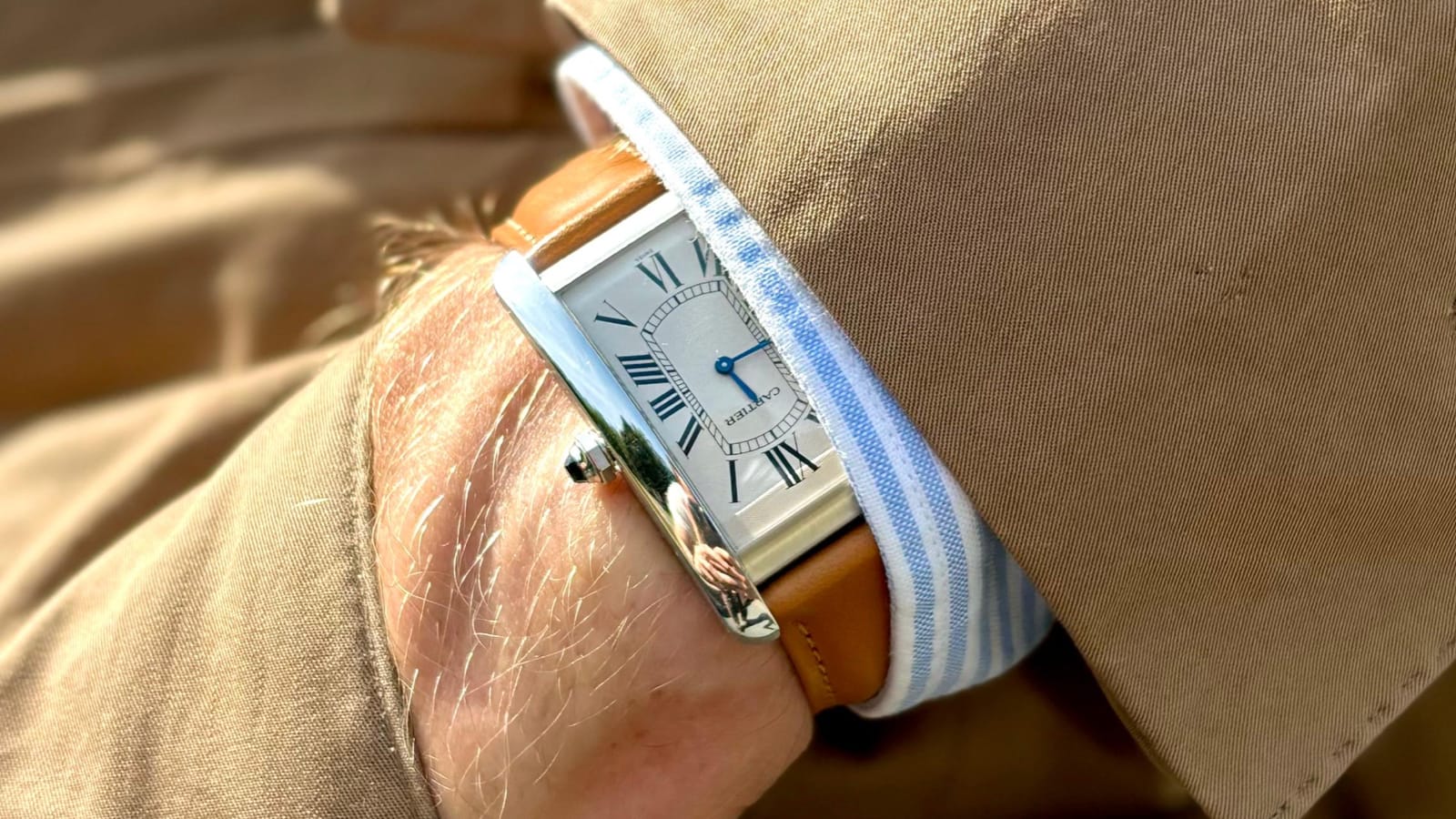
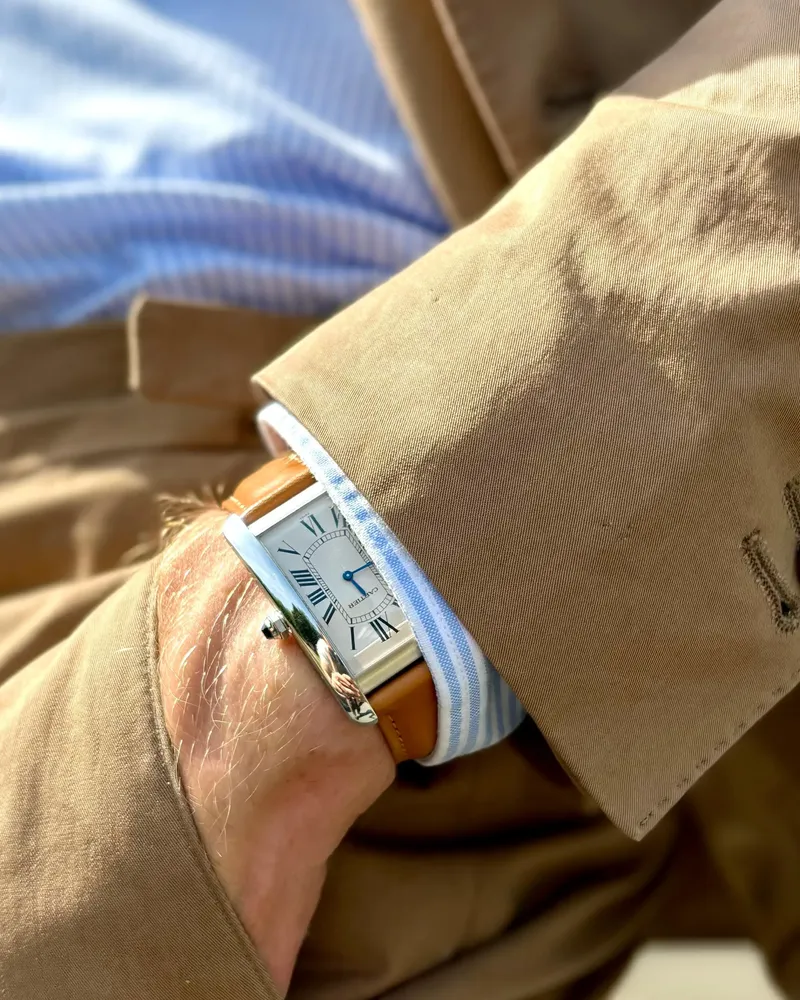
But once, I saw him with my own eyes. It was in Berlin in the early 1990s. As usual, the Zeitgeist was wearing the cloak of history, which always flutters a bit in the wind. A Cartier Tank peeked out from under his sleeve. But it wasn’t just any of those dainty ones or those with flashy shapes. The Zeitgeist was wearing a Tank Américaine.
Of course, he’s always the first, and the model had only been launched in 1989 for the 80th anniversary of Cartier’s US branch. It was truly American. Just as Americans also speak English, but a different kind, the Tank Américaine also played with the design language of all Tanks—brancards, Roman numerals, and a chemin de fer—but differently. It was much larger and more powerful than earlier Tank models; more skyscraper-like, it embodied the motto "the sky is the limit."
“You see that building? I bought that building 10 years ago. My first real estate deal. Sold it 2 years later, made an $800,000 profit. It was better than sex. At the time I thought that was all the money in the world. Now it’s a day’s pay.”
Gordon Gekko (played by Michael Douglas) in the movie “Wall Street” from 1987.
It was a perfect fit for the times. The 1980s had a broad-shouldered silhouette; it was all about power and making an impression. In the era’s defining film, “Wall Street”, Gordon Gekko shows that greed is good and how to live the high life: excessively. In the novel “The Bonfire of the Vanities”, we follow the breathless daily life of a stockbroker who sees himself as one of the “Masters of the Universe”, ruling society and celebrating himself with uninhibited consumerism.
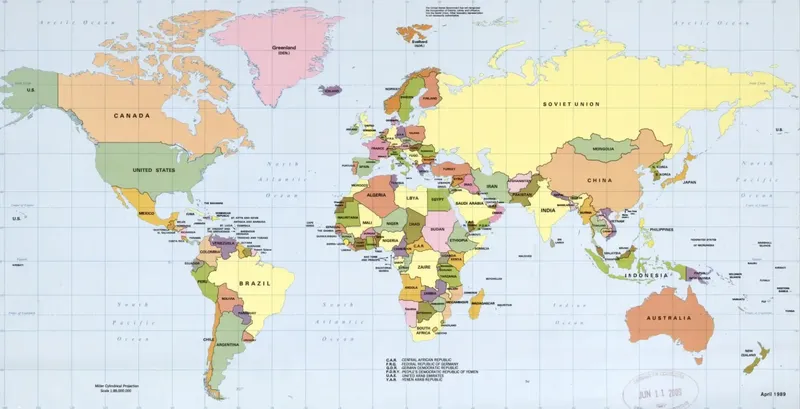
It’s the era of the yuppies. They and their youthful counterparts—preppies in the US, Poppers in Germany, Sloane Rangers in England, or Paninari in Italy—don’t want to change society. They want to be at its top, and they want everyone to see it. The excess is only curbed by the fear of a Third World War between the West and the Eastern Bloc. This is especially hard to ignore in Germany, where the dividing line between West and East runs through the middle of the country as a wall with barbed wire, automatic firing systems, and watchtowers, and the sound of fighter jets practicing for an emergency is familiar even to children. The world lives in two hostile, opposing realities.
Source
United States Central Intelligence Agency. Political map of the world, April. [Washington, D.C.: Central Intelligence Agency, 1989] Map. https://www.loc.gov/item/2010585495/.
The political world map of 1989.
In the end, it’s not tanks that decide which side prevails, but culture. The people in the Eastern Bloc countries stand up for freedom, democracy, and individualism and overthrow the regimes. When the Berlin Wall falls in 1989 and the entire Soviet empire to the east of it soon collapses, everything changes. In the summer of 1989, political scientist Francis Fukuyama whispers to the Zeitgeist that the “end of history” has arrived. The triumph of the Western idea is total: individualism and consumerism will now spread across the entire globe.
The “Wind of Change” indeed soon blows from Hanover to Moscow’s Gorky Park. It feels like a relief from many worries. A feeling hangs in the air everywhere, as present as the smell of wet grass in May: the feeling of an unbridled new beginning under the Pax Americana, heading into a prosperous future of freedom and democracy, but also of consumption and partying.
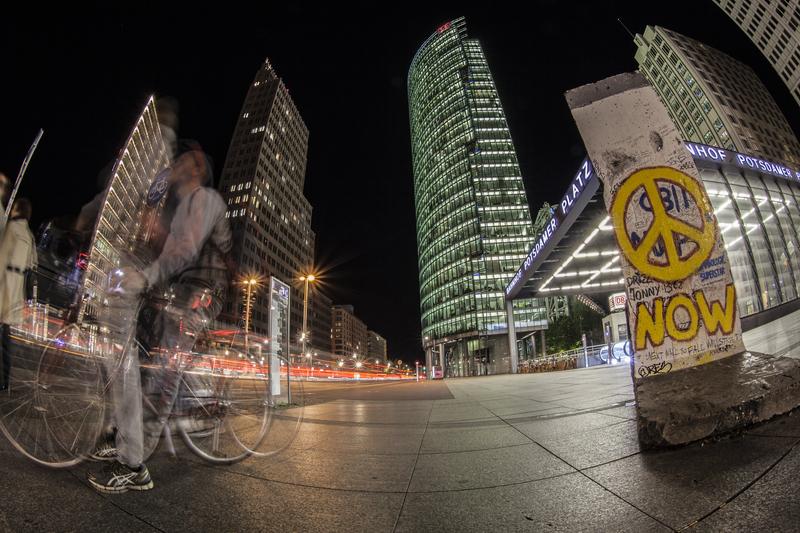
The Zeitgeist is, of course, at the epicenter, in Berlin. I saw it as it strode across Potsdamer Platz, the largest construction site in Europe. Here, the divided city, the divided country, and the divided continent were being reconnected with new buildings—with Germany’s attempt to replicate American skyscraper urbanity.
As I watched the Zeitgeist in front of this somewhat pathetic attempt at architectural mimicry of the USA, I understood that his Cartier was not just an accessory of the late 1980s. The Tank Américaine was more: a symbol of the cultural ideal on its wrist, which dominated not only the center of the new Berlin in stone and concrete, but the entire culture all the way to Vladivostok. Everything would eventually become like this.
The Tank Américaine was the ideal watch for the time after the end of history.
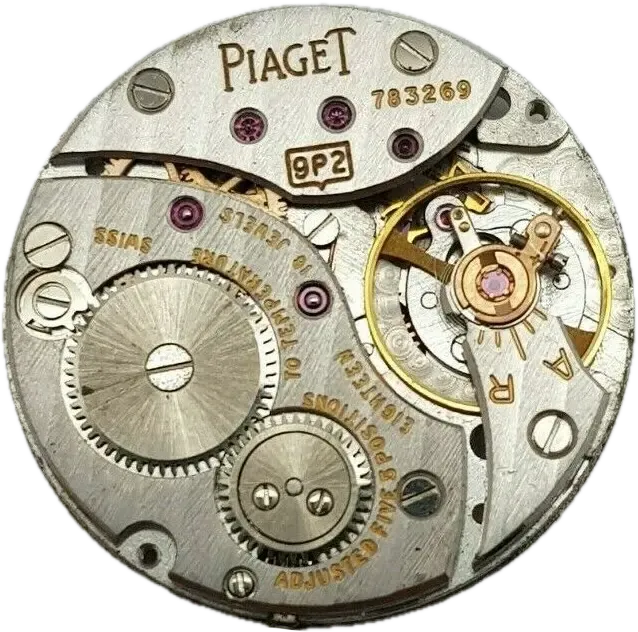
One reason for this is that it’s a two-hander. For the time after the end of history, a seconds hand and date are a nuisance. A two-hander always seems to linger, stoically still. Its drive pulses through time at a leisurely 2.75 Hz. The Piaget 9P2 movement can afford this nonchalance, having already set the still-relevant benchmark for extra-flat movements in 1957 with a movement height of just 2 mm. It is also committed to tradition: with a size of nine lignes, its width remains exactly within the dimensions of the original Cartier Tank.
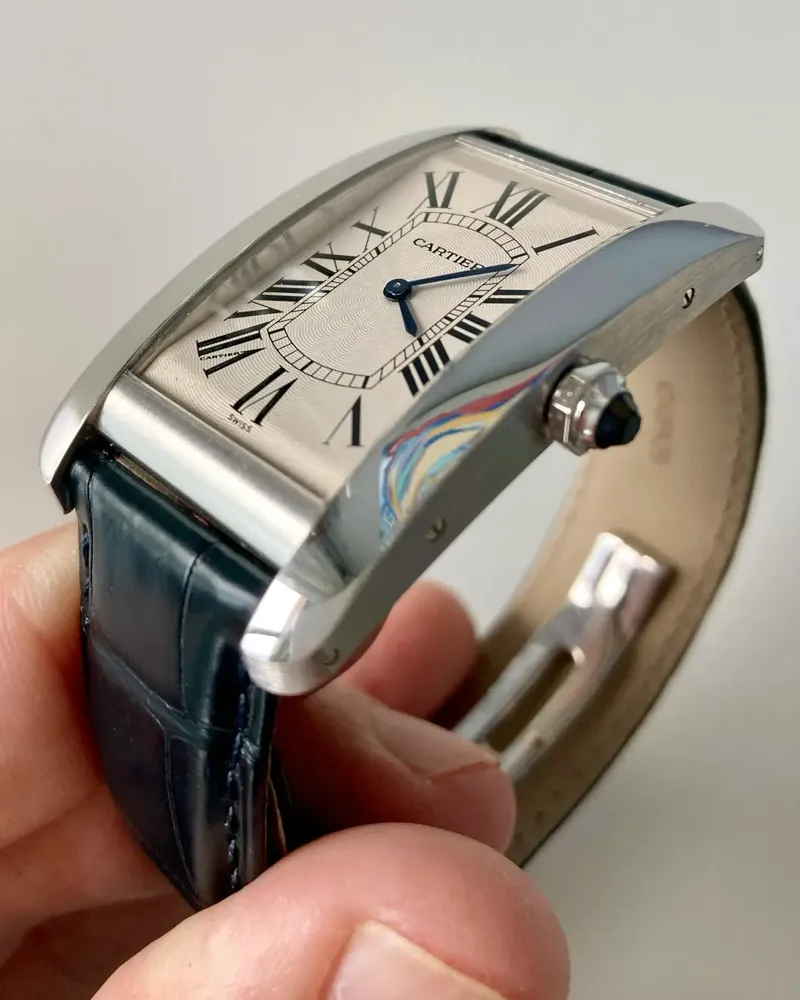
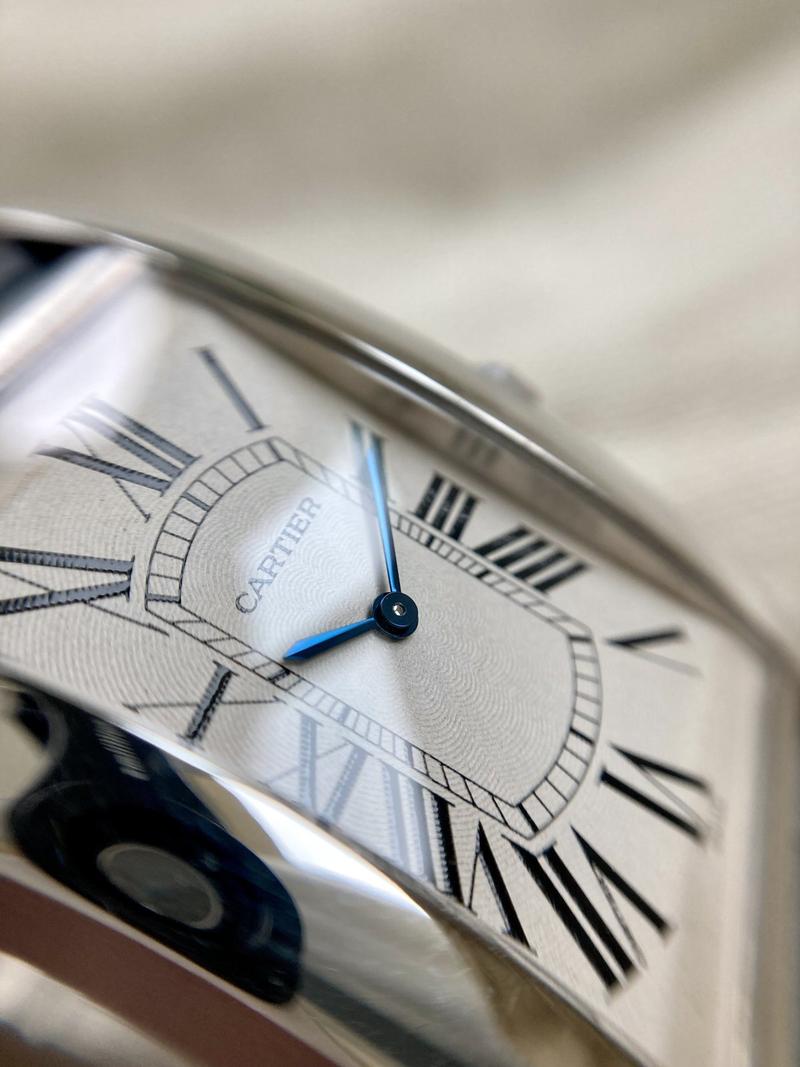
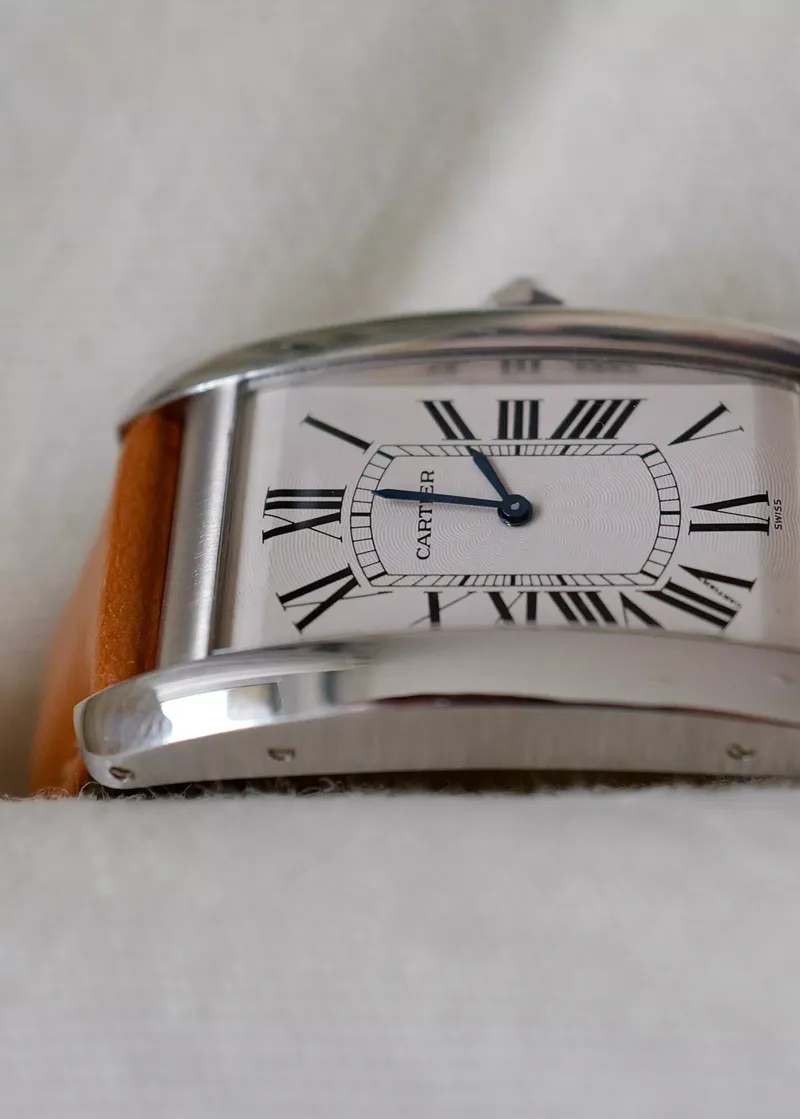
Another reason is the dial. Its very finely embossed guilloché pattern offers the stylistic confidence of a tradition over 200 years old. The Roman numerals even allude to the West’s origins in antiquity, well over 2,000 years ago. Yet the numerals, through the graphic mediation between the circular motion of the hands and the rectangularity of the dial, are curved and stretched like Einstein’s relative time itself, flowing over the edge of the dial as if painted by Dalí.
Over the years, the dial has also taken on a warm, off-white ivory tone, so that with just a little poetic effort, it looks like a hand-engraved cameo from the foot of Vesuvius. Despite the attention to detail, the dial also radiates complete tranquility because its dimensions of 30 × 18.3 mm correspond to the Golden Ratio. Who would want to argue with Leonardo da Vinci about beauty?
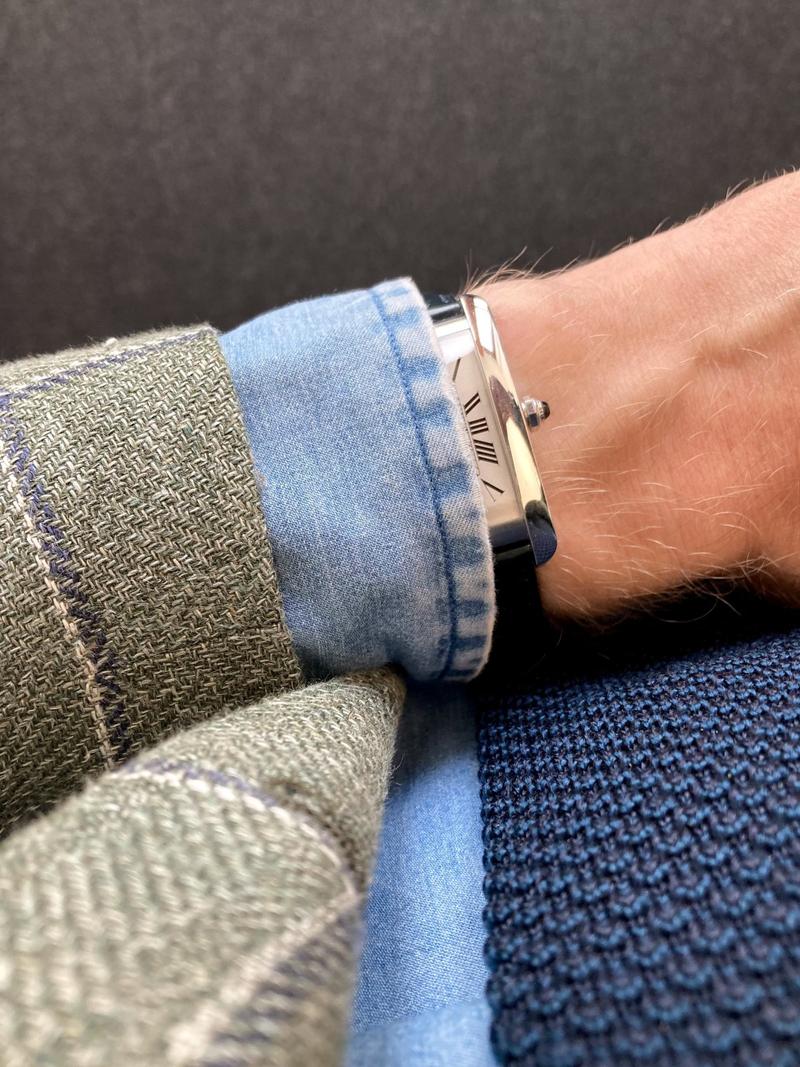
Finally, it’s also due to the shape of the Tank case, which for over 100 years has blended the basic forms of rectangle and oval, of technology and nature, familiar to every child. The watch presents itself as an artifact, yet at the same time nestles organically around the wrist. The shape of the case curves into the strap, and the ingenious deployant clasp, with its stepless adjustability, reflects the uniqueness of the individual.
The classic Tank was launched in the context of the First World War. Its shape referenced
the invention of the tank. It is a symbol of faith in technology and progress. The Tank Américaine
arrived in 1989 as the West triumphed and the East collapsed, in the summer when Fukuyama
saw the end of history and in the autumn when people danced on the Berlin Wall. It doesn’t reference technology,
but culture. The Tank Américaine is armed with the soft power of the West’s cultural cachet.
Today we know things turned out differently. After the supposed end of history, the endless toils of the plains began very soon after. I never saw the Zeitgeist again.
Perhaps it should have looked more closely at the Tank Américaine back then. Its curved sideline also reflects the thousands of years of experience of the rise, flourishing, and decline of civilizations.
Fin.
Buyer’s Guide
About the Brand
Cartier was originally a true luxury manufacturer with distinguished small-batch series for the local Jet Set society. The models therefore differed considerably depending on whether they came from the very independently operating branches of Cartier Paris, Cartier London, and Cartier New York. Since the 1970s, Cartier has evolved from a family business into a management-driven, globally operating mass manufacturer with quite varied quality in its streamlined product range. In the past, there were only watches made of precious metals with high-quality movements; then Cartier expanded to include gold-plated silver and soon also steel models. The movements were often quartz-driven, or simple, mass-produced mechanical movements.
Since 1988, Cartier has been part of the luxury conglomerate Richemont. The strategy of selling a brand rather than a handcrafted product is common among the major brand conglomerates. They supply the aspiring but status-insecure middle classes worldwide with symbols of their success. It works for Cartier. They are the second-largest watch manufacturer in the world by revenue, after Rolex. Unlike Rolex, however, there is also a department of Haute Horlogerie. While the masses are catered to with simple steel models, Cartier has built up impressive in-house expertise as a watch manufacturer since 2005.
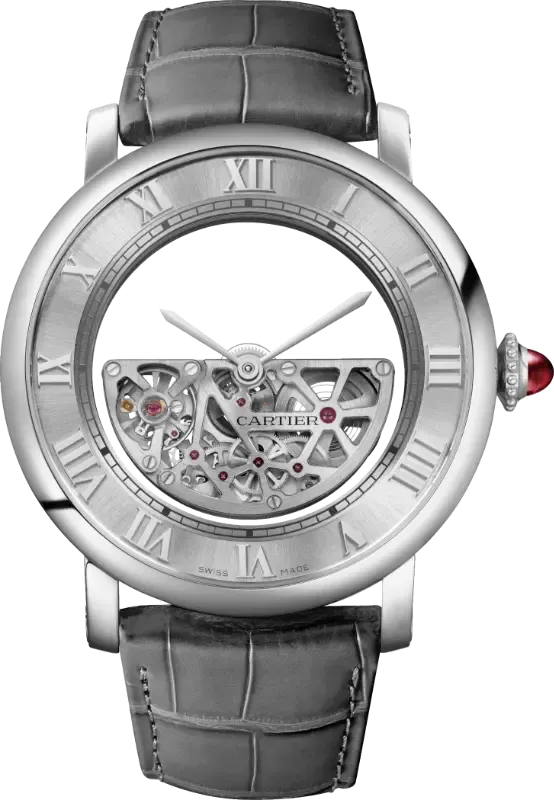
Rotonde de Cartier masse mystérieuse.
In addition, Cartier is very successful at reissuing historical models from its back catalog in limited series, thereby attracting collectors as well as the glitterati. Through this dual strategy, the brand manages the balancing act between mass sales and perceived exclusivity.
About the model line
The visual similarity of the Tank Américaine’s case to the Tank Cintrée is striking. Cartier had designed the Cintrée’s conspicuously elongated Tank shape so that the curved case would follow the shape of the wrist. The first Tank in 1917 had been revolutionary with its rectangular shape, because it emphasized the lugs for wearing on the arm, thus distinguishing itself as much as possible from round pocket watches. The Cintrée was the next logical step, an ergonomic evolution. For subsequent Tank variations, Cartier focused more on cultural references like the Chinoise, or became—around the time LSD was becoming widespread—very experimental, as with the Crash.
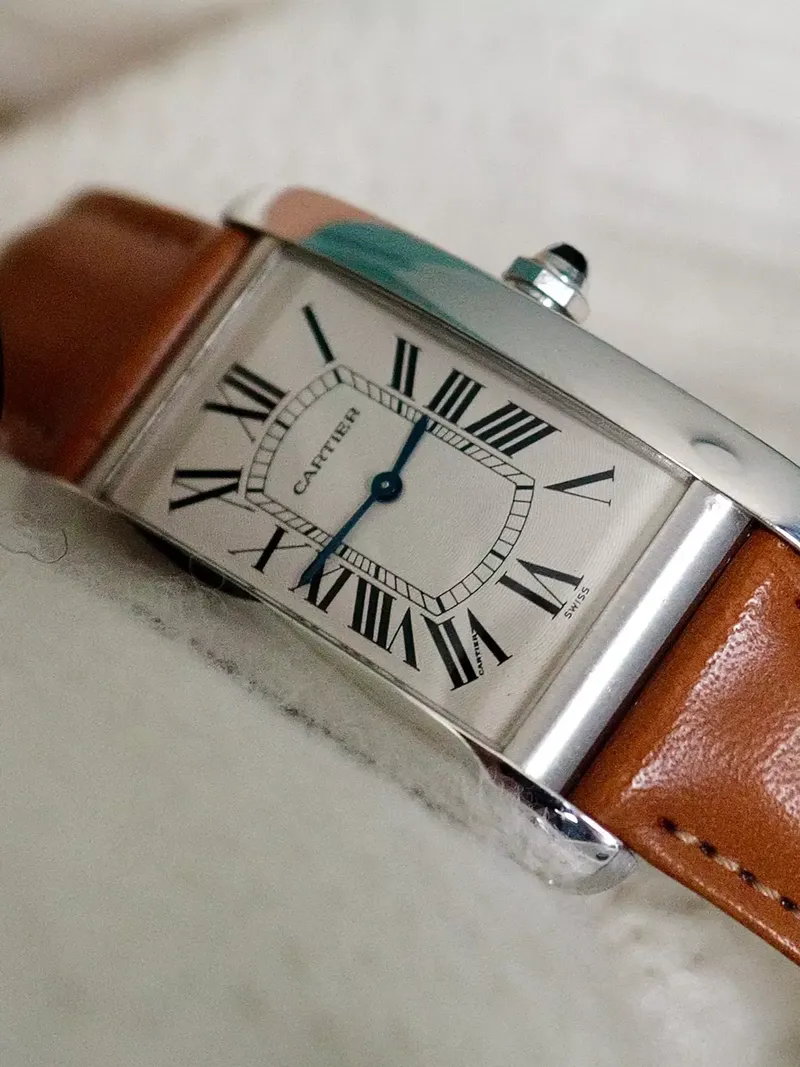
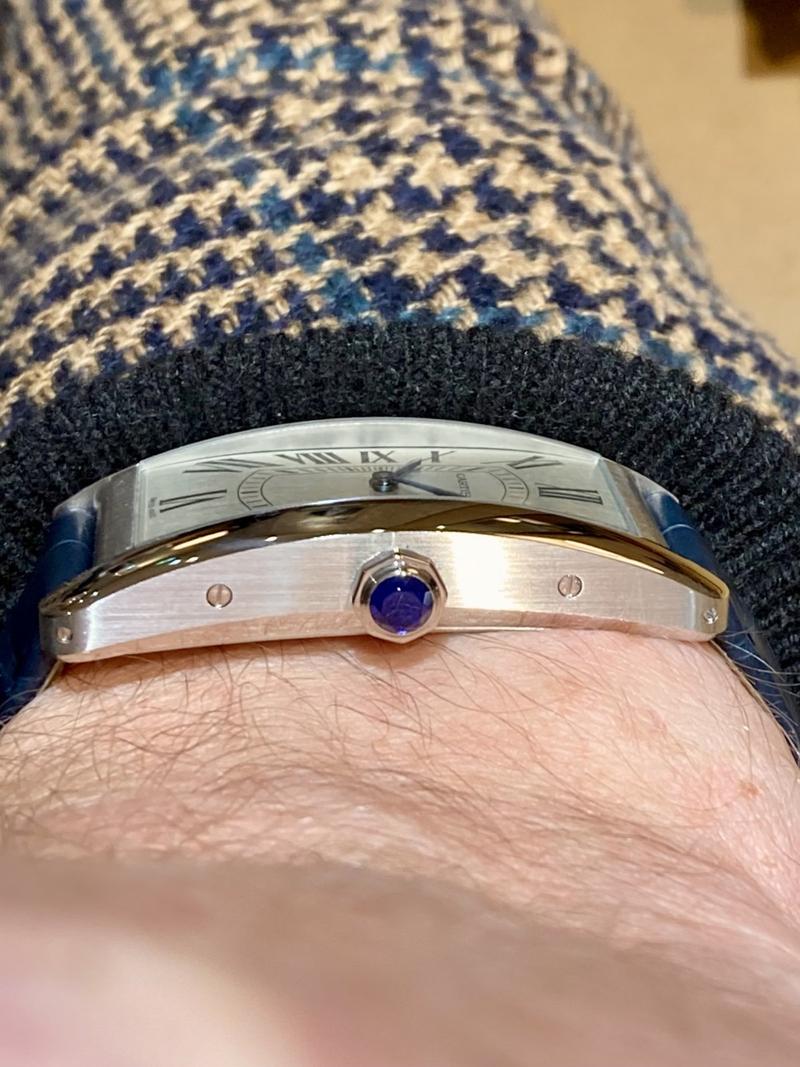
The Américaine now interpreted the typical design language of Art Deco details and the Cintrée’s lines in the power mode of the late 1980s, and with genuine technical innovations for even more ergonomics. Seen from the side, as a unit with the strap and clasp, it forms an elliptical shape that can indeed be adapted to the natural wrist thanks to the stepless clasp. It was also the first Cartier to be water-resistant despite the complex shape of its crystal. Even the crown doesn’t have the typically delicate contour of a Tank, but the easy-to-grip shape of a bolt head. The Tank Américaine therefore holds an interesting position in the Tank family tree as an authentic evolution of the hyped Cintrée, a fact that has not yet been fully appreciated.
The Cartier Tank Américaine does not fit neatly into the lineup. Until a few years ago, the Tank Américaine was only available in precious metals, but initially only with simple quartz movements. It wasn’t until the 1990s that mechanical movements and the then-sensational Chronoreflex by F. Piguet were housed in the case. Today, the Tank Américaine in steel ranks only slightly above Cartier’s entry-level segment and features the typical entry-level Cartier movements.
About Reference 1735
From a collector’s perspective, the CPCP variants produced from 1998–2008 (the small series Collection Privée Cartier Paris, with a maximum of 150 pieces depending on the precious metal) and the concurrently sold series 1734, 1735, and 1736 (platinum, yellow gold, white gold) presented here are therefore interesting. White gold was available as a case material from 1995 and is rare even in relation to the overall scarce model. Chrono24 has not even cataloged this variant yet.
While all CPCP Cartiers have long been discovered by collectors and are traded at high prices, it is little known that this 1734/1735/1736 series is completely identical in construction to the CPCP variant—except for the detail of the "Paris" lettering on the dial. The central element of both lines is the high-quality hand-wound movement, the classic Piaget 9P/9P2 caliber. It not only establishes a connection to the traditional Cartier watches from their golden age, but it is also the only reason the proportions and the truly curved shape are possible. The automatic variants are more clumsily designed due to their height and have a bulge on the back for the movement. Both ruin the look and greatly reduce wearing comfort. The seconds hand and date window are concessions to the mass market that devalue the clean design.
Because this model is little known even among collectors, prices have not yet skyrocketed and are significantly below the CPCP variant.
Help with your search
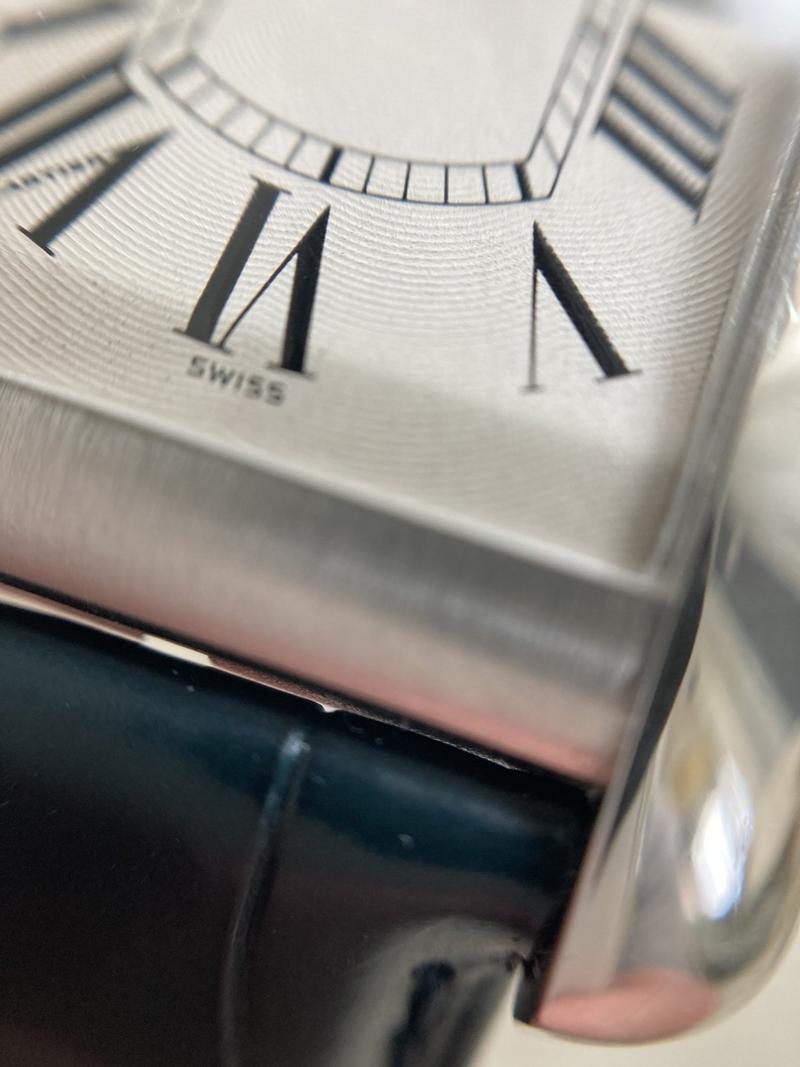
When searching for pre-owned watches, you must pay particular attention to the condition of the case, as the watches have often been excessively polished. This is quite easy to spot even in photos if the gold screw-in strap bars are no longer recessed into the flank but sit flush or even protrude. The flank should also be cleanly matte-finished.
Furthermore, it has a significant impact on the value if the set includes only a white gold Cartier pin buckle instead of the now-discontinued stepless deployant clasp. Alternatively, there was also a white gold bracelet for those who need the Midas touch.
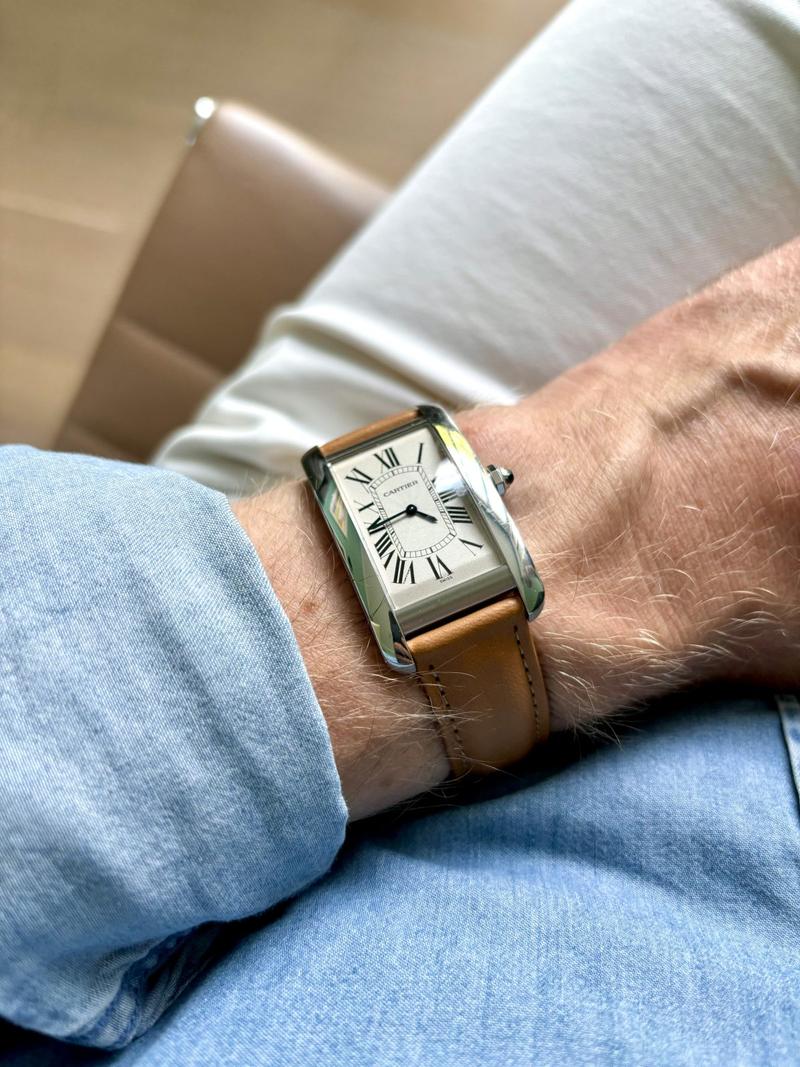
The proprietary-designed leather strap can still be ordered from Cartier today and can even be customized in length and color. With a little patience, you can also take measurements yourself and have the strap custom-made. I have both bought one from Cartier (€275) and had one custom-made from the same leather used by Hermès by J.B. Straps on Instagram (€100), and I can recommend both options.







Write a comment